.png)



Need Pest Control in Lufkin for Pest Challenges Unique to the Piney Woods Region?
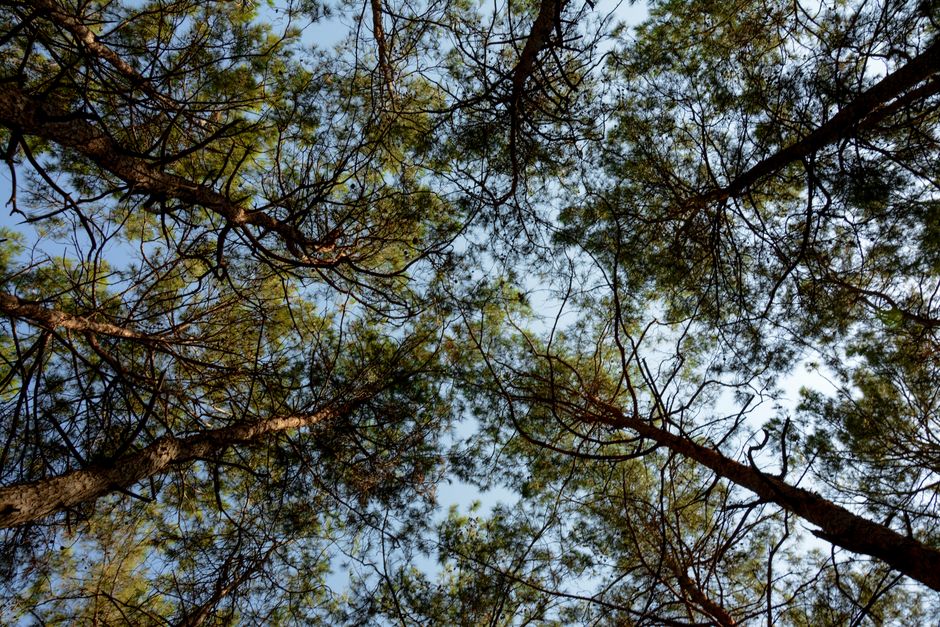
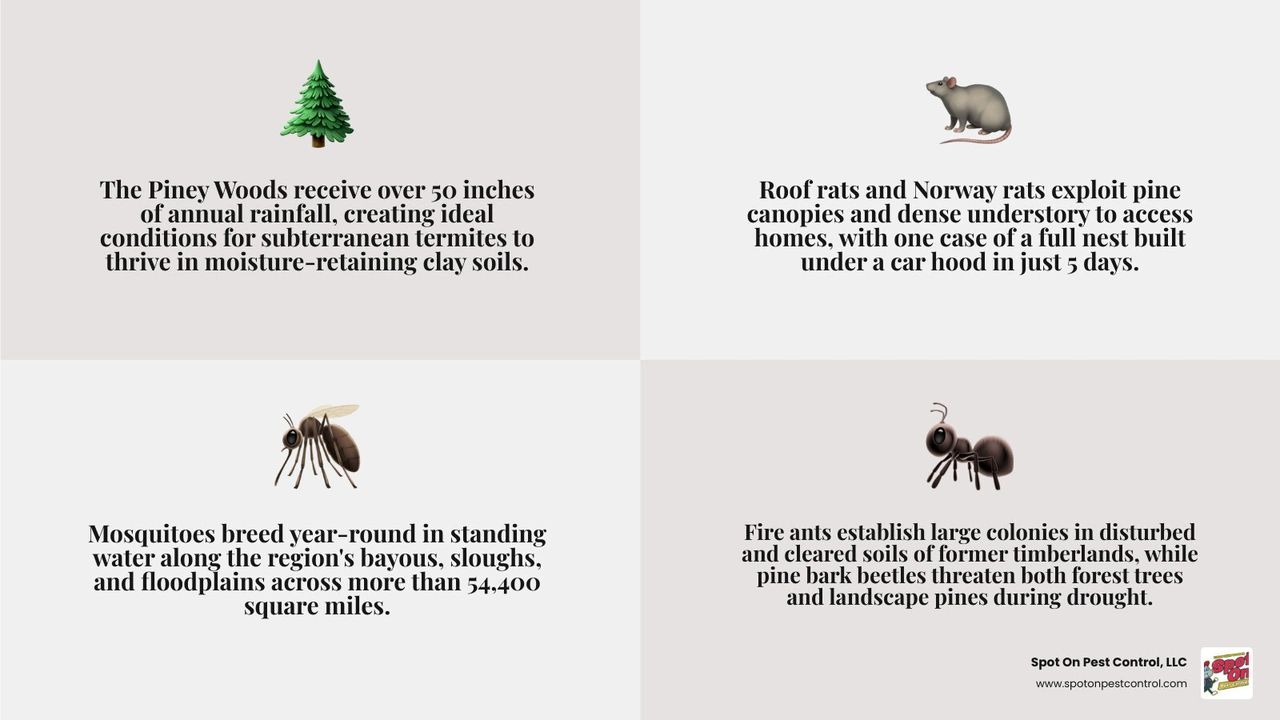
The pest challenges unique to the piney woods region of East Texas are unlike those found almost anywhere else in the state. With over 50 inches of annual rainfall, towering loblolly pines, dense forest canopy, and a network of bayous, sloughs, and wetlands stretching across more than 54,400 square miles, this region creates near-perfect conditions for a wide range of persistent and destructive pests.
The most common pest challenges unique to this region include:
- Subterranean termites — thriving in moisture-retaining clay soils near home foundations
- Mosquitoes — breeding year-round in standing water along floodplains and bayous
- Roof rats and Norway rats — using pine canopies and dense understory to access homes
- Cockroaches — exploiting the warm, humid indoor and outdoor conditions
- Fire ants — establishing large colonies in the region's disturbed and cleared soils
- Pine bark beetles — threatening both forest trees and landscape pines during drought
- Venomous snakes — including five species active across the region's diverse ecoregions
- Carpenter ants — accelerating wood decay in pine-heavy structures
What makes this region especially difficult to manage is the combination of ecological factors working together. The humid subtropical climate accelerates pest reproduction. The dense forest edge constantly pushes wildlife and insects toward homes. And the region's history of timber harvesting and habitat fragmentation has displaced native predators, allowing invasive species like the roof rat, house mouse, and feral pig to fill the gaps.
One East Texas resident learned this the hard way when rats chewed through their vehicle's firewall and built a complete nest under the hood in just five days — a stark reminder of how fast pest problems escalate in this environment.
Whether you own a home in Lufkin or live near the East Texas Piney Woods, understanding the specific pest pressures of this region is the first step toward protecting your property, your family, and the sensitive ecosystem around you. For help from a family-owned pest control company guided by Christian values, call Spot On Pest Control, LLC at (936) 398-8381.
Pest challenges unique to the piney woods region further reading:
- how east texas climate creates unique pest challenges
- how heat and humidity increase pest activity in texas
- how pine forests and moisture attract pests
How the East Texas Climate and Ecoregions Fuel Pest Challenges Unique to the Piney Woods Region
To truly understand the pest challenges unique to the piney woods region, we have to look at the ground beneath our feet and the air we breathe. As of July 2026, the Piney Woods ecoregion covers about 54,400 square miles across East Texas, southern Arkansas, western Louisiana, and southeastern Oklahoma. This vast landscape is not uniform; it is divided into highly localized Level IV ecoregions that dictate soil types, water drainage, and vegetation.
For example, the wet Flatwoods and low-gradient Floodplains and Low Terraces feature heavy, clayey soils that do not drain water easily. Combined with an annual precipitation rate that ranges from 40 to 52 inches—and often exceeds 60 inches in the wettest pockets—these areas create persistent standing water. This water collects in slow-moving bayous, sloughs, and shallow depressions known as baygalls. This environment provides the perfect, undisturbed breeding grounds for mosquitoes, midges, and other moisture-loving pests.
Conversely, the Tertiary Uplands and Southern Tertiary Uplands consist of sandy and loamy soils. While these soils drain more quickly, they are highly susceptible to subterranean termites, which can easily tunnel through the loose earth to reach residential foundations.
Because our climate is humid subtropical, we experience long, hot summers and incredibly mild winters. This lack of a sustained hard freeze means that many insect populations never experience a true winter die-off. Instead, they remain active or semi-active year-round, accelerating their breeding cycles and constantly seeking entry into our homes. To learn more about how this environment influences local pests, read our detailed article on How East Texas Climate Creates Unique Pest Challenges.
High-Risk Pests in Lufkin and the Surrounding Piney Woods
Living in Lufkin or surrounding communities like Diboll and Huntington means sharing our space with an incredibly diverse array of wildlife and insects. While many of these creatures are vital to our local ecology, they become high-risk hazards when they cross the threshold into our living spaces.
To help you identify the common threats around your property, we have put together a comparison of the native and introduced pest species that frequently cause trouble for East Texas homeowners:
| Pest Category | Native Species | Introduced / Invasive Species | Primary Risks & Behaviors |
|---|---|---|---|
| Rodents | Southern flying squirrel, Baird's pocket gopher, woodland vole, muskrat | Roof rat, Norway rat, house mouse, nutria | Structural chewing, electrical fire hazards, chewing vehicle wires, pathogen transmission. |
| Insects | Subterranean termites, carpenter ants, native paper wasps, mud daubers | Red imported fire ants, Asian tiger mosquitoes, German cockroaches | Wood destruction, painful stings, vectoring diseases like West Nile virus, rapid indoor breeding. |
| Reptiles | Eastern copperhead, northern cottonmouth, timber rattlesnake, pygmy rattlesnake | Feral house cats (predatory threat to native reptiles and birds) | Venomous bites, nesting under pier-and-beam foundations or in thick brush. |
The extreme heat and moisture of our region play a massive role in how these species behave. For a deeper dive into these environmental factors, check out our guide on How Heat and Humidity Increase Pest Activity in Texas.
Wood-Destroying Insects and Termite Pressures
In a region dominated by commercial forestland and pine timber, wood-destroying insects are a constant threat. Subterranean termites are by far the most destructive pests in East Texas. They live in massive underground colonies and construct pencil-thin mud tubes up concrete slabs or pier-and-beam supports to reach the wooden framing of your home. Because our clayey soils retain moisture near home foundations, termites find highly favorable conditions right at our doorsteps.
Carpenter ants present another major structural challenge. Unlike termites, carpenter ants do not eat wood; instead, they hollow it out to build their nests. They are highly attracted to soft, decaying wood. In the Piney Woods, the combination of high humidity and frequent rain leads to rapid wood decay in fascia boards, roof decking, and crawlspaces.
Once wood rot sets in, carpenter ants and termites quickly move in to expand the damage. We cover these specific attraction factors in detail in our article on How Pine Forests and Moisture Attract Pests.
Invasive Rodents and Wildlife Encroachment
Our local forests are home to beautiful native rodents like the southern flying squirrel and the Baird's pocket gopher. However, introduced species like the roof rat, Norway rat, and house mouse are highly aggressive and readily adapt to human structures.
Roof rats are incredibly agile climbers. They utilize the overlapping branches of loblolly pines, sweetgums, and thick American wisteria vines to leap directly onto residential roofs. Once on the roof, they chew through soffit vents, ridge caps, and plumbing boots to establish nests in warm attic insulation.
Furthermore, the clearing of forests has driven wildlife closer to residential areas. Over 30 species of snakes occur in the Piney Woods, including five venomous species:
- Texas coralsnake
- Eastern copperhead
- Northern cottonmouth
- Timber rattlesnake (state-listed as threatened in Texas)
- Pygmy rattlesnake
While these snakes are essential for keeping rodent populations in check, encountering them in your flowerbeds, under your porch, or near your pier-and-beam foundation can be dangerous.
How Timber Industry History and Habitat Fragmentation Affect Local Pests
The Piney Woods region contains approximately 50,000 square kilometers (about 12,000,000 acres) of commercial forestland. Historically, this area was covered in diverse, old-growth forests, including open longleaf pine savannahs and massive bottomland hardwood forests.
However, over 75 percent of the original bottomland hardwood forests in the Southeast have been lost or degraded due to logging, agriculture, and reservoir construction. Today, the World Wide Fund for Nature considers the Piney Woods to be one of the critically endangered ecoregions of the United States, with a habitat loss rate of 22.235% and only 11.03% of the land designated as protected.
This dramatic shift from diverse, uneven-aged old-growth forests to dense, even-aged loblolly pine plantations has significantly altered pest dynamics.
Understanding Bark Beetle Dynamics and Pine Forest Pests
One of the most clear examples of how forest changes impact pests is the behavior of pine bark beetles. Historically, the Southern Pine Beetle (Dendroctonus frontalis) was the most destructive pest in East Texas commercial timber, capable of killing tens of thousands of acres of pine trees. Interestingly, there have been zero reported cases of Southern Pine Beetle on state and private lands in East Texas since 1998.
Instead, current tree mortality is driven by Ips engraver beetles (including the sixspined, fivespined, and small southern pine engraver) and the black turpentine beetle. These beetles typically target individual trees that are already stressed by summer droughts, soil compaction from construction, or root damage.
In a healthy forest, these beetles are kept in check by natural predators like the clerid beetle (Thanasimus dubius). When Southern Pine Beetle populations crashed, the predatory clerid beetles survived by switching to feed on Ips engraver beetles as alternative prey.
Because of this delicate ecological balance, large-scale chemical spraying is highly discouraged, as historical attempts in the 1960s actually killed more slow-breeding predatory clerid beetles than they did the pest beetles, lengthening the outbreaks. Instead, proper forest management—such as thinning young pine stands to a tree spacing of at least 20 feet (6 meters)—keeps trees healthy and naturally resistant to beetle attacks.
How Deforestation Drives Pest Challenges Unique to the Piney Woods Region to Seek Shelter
As timber harvesting and urban development fragment the dense pine forests, wildlife is forced to adapt. Native species like the nine-banded armadillo and coyote have expanded their ranges, while invasive species like feral pigs and feral house cats have established massive, destructive populations.
When their natural forest habitats are cleared, rodents, snakes, and insects are forced to migrate directly into nearby residential neighborhoods.
This is especially problematic for homes with pier-and-beam foundations, which are incredibly common in older neighborhoods throughout Lufkin. The open crawlspaces beneath these homes provide easy access and attractive shelter for:
- Feral cats and feral pigs looking for shade or warmth
- Rats and mice seeking dry nesting materials
- Venomous snakes chasing those rodents directly into the crawlspace
- Subterranean termites traveling up the wooden piers
Navigating Seasonal Pest Cycles and Supporting Native Predators
In East Texas, we do not just have four seasons; we live through a dynamic cycle of humid summers, seasonal flooding, and occasional drought-induced fire cycles. Each of these environmental shifts directly triggers changes in pest behavior.
The Six Southern Pest Seasons and Weather Extremes
To manage pests effectively in our humid subtropical climate, we divide the year into six distinct biological pest seasons:
- Shelter Season (January – February): As winter brings cooler wet weather, rodents (including roof rats and house mice) and cockroaches seek warm shelter inside attics, crawlspaces, and wall voids.
- Swarm Season (March – April): Rising temperatures trigger subterranean termites to swarm in search of new nesting sites. This is also when the mosquito season kicks off, stretching all the way through November.
- Breeding Season (May – June): With consistent warmth and spring rains, insect reproduction explodes. Ants, wasps, and spiders actively build nests around rooflines and foundations.
- High Season (July – August): Peak summer humidity and temperatures in the 90s accelerate insect life cycles. During dry spells, pests like roaches and ants aggressively invade homes in search of water.
- Prep Season (September – October): As days shorten, spiders spin prominent webs, and rodents begin scouting structural entry points to prepare for winter.
- Invader Season (November – December): The first true cold fronts drive outdoor pests, including overwintering beetles and rodents, indoors to find warmth.
Coexisting with Beneficial Predators for Natural Pest Control
One of the most effective ways to manage the pest challenges unique to the piney woods region is to let nature do the heavy lifting. Our local ecosystems are home to incredible native predators that act as our original, eco-friendly pest control systems.
For example, the Piney Woods are home to 11 native bat species, including the threatened Rafinesque's big-eared bat (Corynorhinus rafinesquii). A single bat can consume thousands of nocturnal insects—including mosquitoes, moths, and beetles—in a single night.
Similarly, the timber rattlesnake (Crotalus horridus) is a docile, non-confrontational predator that acts as a highly effective regulator of wild rodent populations.
We can support these natural allies by:
- Installing custom bat boxes on our properties to provide safe roosting sites
- Avoiding the use of broad-spectrum chemical pesticides that eliminate their food source
- Practicing basic snakebite prevention (using a flashlight at night, looking before placing hands in brush) and allowing native snakes to retreat undisturbed rather than harming them
Balancing Effective Pest Control with Conservation in East Texas
Because the Piney Woods is a critically endangered ecoregion home to sensitive ecosystems and rare species—like the red-cockaded woodpecker and the Louisiana pine snake—we must balance home protection with environmental conservation.
Traditional, heavy-handed chemical spraying can run off into local waterways, harming aquatic life and disrupting the natural food chain. For a sustainable approach, we look to modern, localized strategies. You can read more about our specific local approach on our East Texas Pest Control resource page.
Proactive Prevention and Eco-Friendly Management Strategies
At Spot On Pest Control, LLC, we utilize Integrated Pest Management (IPM). This approach focuses on long-term prevention by managing the environment rather than relying solely on chemical sprays.
Our core eco-friendly strategies include:
- Moisture Control: Fixing plumbing leaks, clearing gutters, and using dehumidifiers to dry out crawlspaces, which deprives termites, carpenter ants, and roaches of the water they need to survive.
- Exclusion Methods: Sealing cracks, crevice entry points, and installing heavy-duty wire mesh over attic vents to physically block rodents and bats from entering homes.
- Botanical-Based Products: Utilizing organic and botanical-based products for target areas, such as our seasonal mosquito control packages (running March through October starting at $69/month) to safely reduce mosquito populations near wetlands without harming beneficial pollinators.
Resolving Pest Challenges Unique to the Piney Woods Region with Targeted Treatments
We don't believe in one-size-fits-all treatments. Because our local soils, building styles, and vegetation vary so dramatically between properties in Lufkin, we design customized treatment plans for every home.
By conducting regular inspections and focusing on early detection, we can stop destructive pests like termites before they cause costly structural damage.
Additionally, we stand firmly behind our specialized services, such as our comprehensive fire ant control, which comes with a full 1-year guarantee to keep your yard safe and free of painful stings.
Frequently Asked Questions about Piney Woods Pests
Why are termites so destructive in the Piney Woods?
The combination of our clay-heavy soils, which trap and retain moisture near foundations, and our humid subtropical climate creates a perfect environment for subterranean termites. Because our homes are situated in a region dominated by pine timber and natural wood decay, termites have a constant, abundant food source and can feed on home framing year-round without a winter pause.
How do seasonal floods affect rodent and insect activity in Lufkin?
When heavy rains cause local bayous and sloughs to flood, rising water levels displace ground-dwelling pests. Rodents, ants, and spiders are forced out of their natural forest floor habitats and migrate to higher ground, which often leads them directly into nearby residential crawlspaces, attics, and living areas. Additionally, receding floodwaters leave behind stagnant pools that trigger massive mosquito breeding surges.
What is the safest way to control mosquitoes near East Texas wetlands?
The safest approach is to combine physical source reduction with eco-friendly treatments. Homeowners should regularly eliminate standing water in gutters, flowerpots, and low spots on their property. For active control near sensitive wetlands, we recommend using botanical-based larvicides and targeted misting treatments that break the mosquito breeding cycle without harming local fish, birds, or beneficial insects.
Conclusion
Managing the pest challenges unique to the piney woods region requires deep local knowledge, a commitment to protecting our beautiful environment, and proactive, consistent care. At Spot On Pest Control, LLC, we are proud to serve our neighbors across Lufkin and the surrounding East Texas communities.
Operating with strong Christian values, we place integrity, compassion, and excellence at the center of everything we do. As a family-owned business, we treat your home with the same care and respect as our own.
If you are ready to experience a proactive, eco-friendly approach to pest management, take advantage of our "first month on us" promotion. Let us help you protect your home, your family, and the unique Piney Woods ecosystem we all call home.
Visit our service page to Protect your East Texas home with professional services.
Our Services
Our pest control services cover ants, termites, bed bugs, rodents, mosquitoes, and other common pests, with customized solutions for both residential and commercial properties.